
Last Updated on March 15, 2026 by Ecologica Life
What an Ancient Reptile Can Teach Us About Longevity, Conservation, and Patience
Table of Contents
Introduction
Imagine waiting more than a century to become a dad.
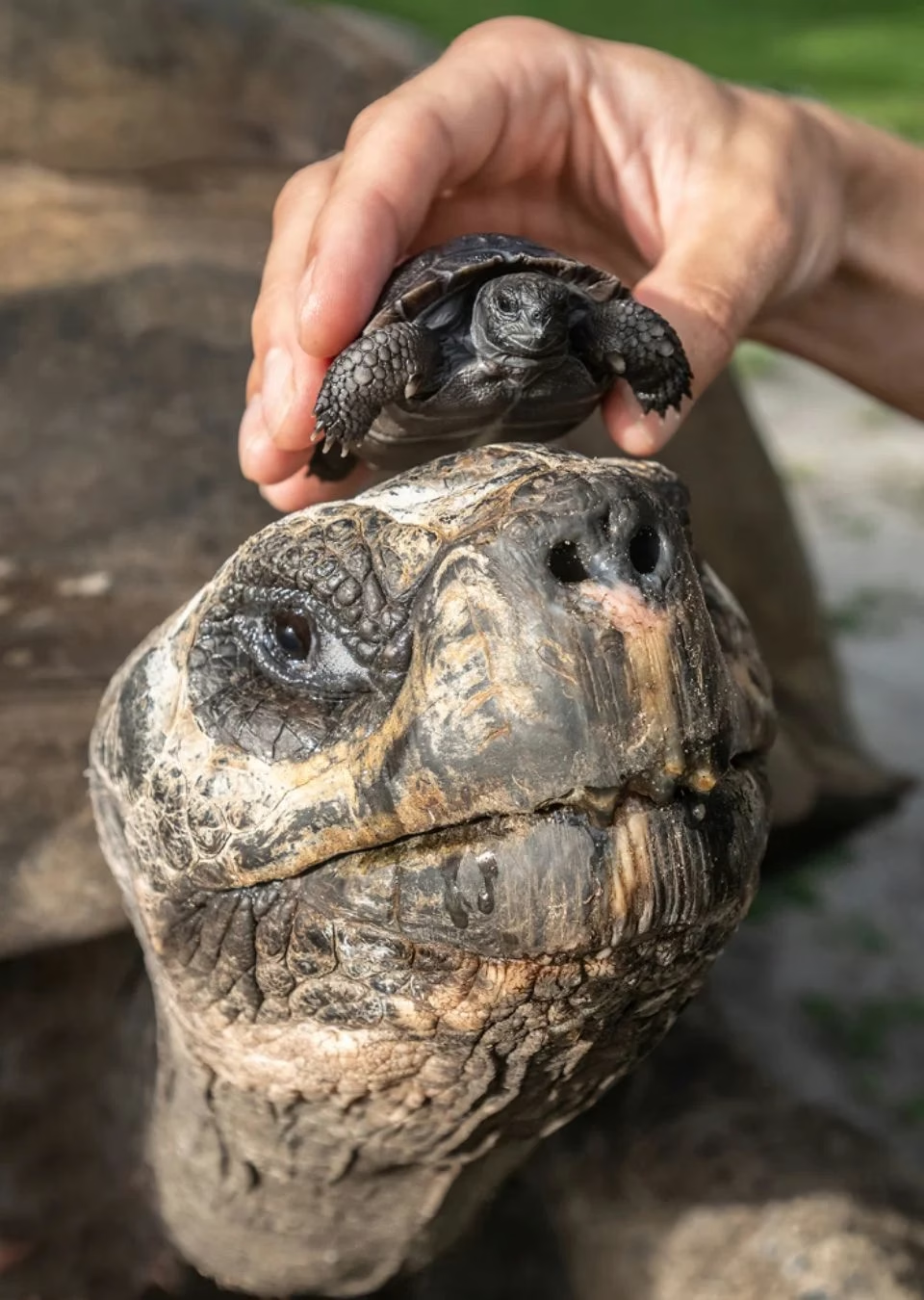
While to date, this seems quite unrealistic for humans,longevity in the animal kingdom can stretch our imagination. In June 2025, a giant Galápagos tortoise named Goliath made headlines around the world after becoming a father for the first time – at the remarkable age of 135 years old.
For conservationists and biologists alike, this event was about more than just a charming wildlife story. It highlighted the extraordinary lifespan of tortoises and the ongoing importance of conservation programmes designed to protect some of the planet’s longest-living creatures.
So, what’s the story behind our friendly centenarian father? And why does this story matter?
The Story: A Century in the Making
Goliath, a 234-kilogram Galápagos tortoise living at Zoo Miami, officially became the oldest known first-time father in recorded animal history.
His story began long before modern conservation programmes existed. According to zoo records:
- Goliath most likely hatched on Santa Cruz Island in the Galápagos around 1890.
- He was brought to the Bronx Zoo in 1929, later relocating to Zoo Miami in 1981.
- Despite mating attempts throughout his life, he had never successfully produced offspring.
On 27 January, a female tortoise named Sweet Pea, estimated to be between 85 and 100 years old, laid a clutch of eight eggs. After 128 days of incubation, one egg hatched on 4 June, creating Goliath’s first offspring.
The moment was historic not only for Goliath but also for Zoo Miami: it was the first successful Galápagos tortoise hatching in the zoo´s history
Why Giant Tortoises Live So long
Galápagos tortoises are among the longed-lived vertebrates on Earth. Lifespans exceeding 100-150 years are common, and some individuals may reach 200 years or more under ideal conditions.
Several biological traits contribute to this remarkable longevity:
1. Slow Metabolism
Reptiles generally have slower metabolic rates than mammals. This means their bodies accumulate cellular damage more slowly over time.
2. Protective Shell and Size
Their large size and heavy shell provide protection from predators, reducing mortality in adulthood.
3. Slow Life History Strategy
Giant tortoises mature slowly and reproduce over many decades. Evolutionarily, this strategy favours long life spans with multiple breeding opportunities across a lifetime.
In other words, a tortoise becoming a father after a century may sound extraordinary, but its a clever strategy and biologically entirely possible.
Conservation Context
This birth also carries big conservation significance.
Giant Galápagos tortoises were once driven close to extinction. Historically, sailors and settlers hunted them for meat and oil. Introduced animals such as goats and rats further devastated populations by destroying vegetation and eating eggs.
Today many tortoise species remain endangered, and captive breeding programs play an important role in preserving genetic diversity.
This is where stories like Goliath’s matter.
Even a single hatchling can:
- Preserve rare genetic lineages
- Support species survival plans in zoos
- Potentially contribute to future rewilding programs
Some tortoise breeding programs have already had extraordinary success. For example, another famous Galápagos tortoise names Diego fathered more than 900 offspring, helping restore wild populations on Española island.
Nature’s Timescale in Context
There is also something profound about this story.
Goliath hatched sometime about 1890, meaning he has lived through:
- Two world wars
- The invention of airplanes
- The rise of the internet
And he has only just now had his first offspring.
In a world driven by speed and instant results, the natural world operates on an entirely different timeline. Conservation, ecosystem recovery, and species survival are frequently multi-generational efforts.
Goliath’s hatching is a reminder that sometimes nature simply requires patience.
Conclusion
The birth of a tortoise hatchling might seem like a small event. But behind it lies a much bigger story about longevity, conservation, and the resilience of life.
A tortoise born in the 19th century has now helped create a new generation in the 21st.
Not bad for a first-time dad.
And perhaps it raises a simple but powerful question:
If a species can take more than a century to reproduce, can we work together on the scale to make the world a better place?